
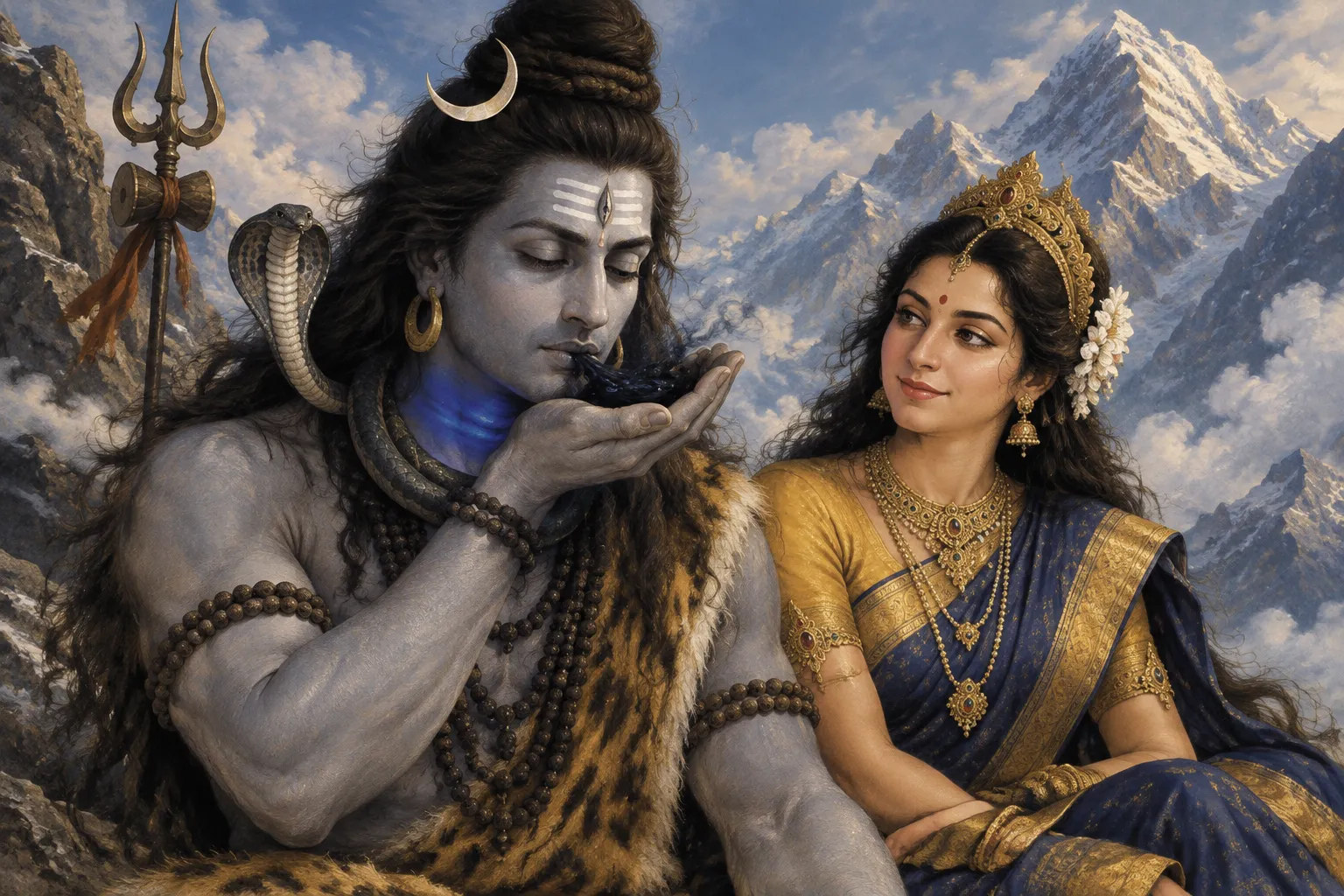
The search is for immortality, but what rises from the ocean threatens life itself. Before the coveted nectar can be enjoyed, poison spreads through the worlds. Shiva answers the emergency by drinking it, and his throat bears a blue mark afterward. In the Bhagavata Purana’s eighth book, chapter seven, that mark becomes an ornament rather than a disgrace.
This reversal is the heart of the story. Why should a trace of poison be beautiful? One possible answer is that it makes an otherwise invisible act of protection visible. The throat is not simply an unusual feature to explain; it becomes a way of remembering what Shiva has done for others.
The account below distinguishes the Bhagavata narrative, read through the Bhaktivedanta Book Trust translation, from Tamil Shaiva interpretations discussed by M. A. Dorai Rangaswamy and from a particular South Indian bronze. These witnesses illuminate the same rescue without preserving every detail identically.
1. The rescue hidden inside the search for nectar
In the Bhagavata account, devas and asuras churn the Ocean of Milk with Mount Mandara and the serpent Vasuki. Vishnu’s tortoise form supports the mountain. Their effort produces the dangerous poison halahala, and the frightened petitioners seek Shiva and Bhavani on Kailasa. These are the essential circumstances of the crisis described in chapter seven.
Read as a narrative, the episode changes the question from who will receive a desired treasure to who will address an unwanted consequence. The participants know what they hope to gain. They are less prepared for what their shared enterprise releases. That contrast gives the rescue its urgency: the problem cannot be solved merely by wanting the original reward more intensely.
This is an interpretive observation, not a claim that the text offers a modern theory of technological risk. Its value lies in noticing the story’s arrangement. Ambition occupies the foreground until danger interrupts it; protection then becomes more important than possession. Shiva’s intervention asks the reader to attend to the threatened world, not only to those competing for its treasures.
2. Why the blue mark becomes an ornament
Shiva explains his decision in terms of protecting suffering beings. Bhavani assents, knowing his power. He drinks the poison from his palm, and a bluish line appears on his neck. The chapter explicitly treats this line as an ornament and praises accepting suffering for others’ welfare. The ethical emphasis is especially clear in verses 37–44.
One way to read this transformation is to distinguish an ornament that advertises possession from one that records a gift. A jewel can display what its wearer owns. Here, the bodily mark recalls what the protector has taken upon himself so that others may live. Beauty is being judged through action rather than through an untouched appearance.
That reading should not become advice to accept abuse or imitate a divine encounter with poison. The episode concerns extraordinary divine capacity. Its human ethical question is more limited and more useful: when we praise strength, do we mean the ability to prevail over others, or the ability to protect them?
Readers interested in another narrative about power and responsibility can turn to why Durvasa must return to Ambarisha. The connection is thematic, not a claim that the two stories teach precisely the same lesson.
3. Does Parvati hold Shiva’s throat?
A familiar question concerns the goddess’s role. In the Bhagavata passage just discussed, Bhavani gives her assent; it does not describe her physically gripping Shiva’s throat. By contrast, Rangaswamy’s 1958 study of Tamil Shaiva material recounts Parvati pressing his throat to stop the poison descending. His discussion of Vishapaharana imagery and the Karanagama also describes her arm around his neck and an anxious expression.
The distinction matters because a vivid detail can easily migrate into a retelling and then be attributed to the wrong passage. Saying which witness supplies it preserves more of the tradition, not less. Bhavani’s confident assent and Parvati’s protective embrace offer different emotional emphases; neither needs to be erased to make the other intelligible.
As an interpretation, the embrace makes care reciprocal. Shiva protects the worlds, while the goddess’s gesture directs attention toward the protector himself. The scene can therefore be contemplated as more than solitary heroism. Yet that is a reading of the image, not permission to rewrite the Bhagavata verse or to identify every representation by the same formula.
4. How Tamil devotion makes the throat personal
Rangaswamy’s study examines the Tamil poet Arurar, also known as Sundarar. In his account, the poet’s responses range from wonder at Shiva’s drinking to anxious concern for him. The darkened throat becomes beautiful, compared with a precious stone, and the name Nilakantha expresses grace. These observations belong specifically to the study’s treatment of Arurar’s devotional language, rather than to a single universal Hindu interpretation.
What changes when a cosmic rescue becomes the subject of intimate concern? A reader no longer stands at a safe distance, admiring an impressive feat. The act can provoke affection, alarm, gratitude, even a wish that the beloved deity had not needed to undertake it. Such responses need not cancel reverence. They can make reverence emotionally particular.
On this reading, the throat is a point of encounter between immense power and tenderness. The worshipper contemplates not an abstract list of divine abilities but a remembered act with a visible consequence. Calling the mark beautiful becomes a judgment about relationship: this is the sign by which the protector is recognized and loved.
5. A bronze that tells the story without blue paint
The Nelson-Atkins Museum of Art identifies a ninth–tenth-century bronze from the eastern Deccan as Shiva Vishapaharana, the lord who swallowed the world poison. Its label interprets a serpent in his left hand as a symbol of poison. A lower right hand offers blessing while also holding a rosary; the upper hands carry an ax and a deer.
This particular object offers a useful lesson in looking. A sculpture need not reproduce every stage of a narrative to make the narrative present. Nor must a bronze depend on a blue-colored throat. Attributes and gestures can carry the association. The museum’s identification and explanation are important here: viewers should not assume that any serpent-bearing Shiva image necessarily depicts this episode.
We might read the combination of poison symbol and blessing as a compressed statement of the story’s movement: danger is acknowledged, but reassurance is offered. That is an interpretation of the arrangement, not a documented statement of the maker’s intention.
Across these distinct witnesses, the most rewarding question is therefore not only why Shiva’s throat is blue. It is why the trace of danger becomes worthy of loving attention. The answer suggested by this reading is simple: the mark asks us to remember the lives protected, rather than mistake an unmarked appearance for the highest form of beauty.
Sources and further reading
- Bhagavata Purana 8.7, Bhaktivedanta Book Trust translation: the churning crisis, Bhavani’s assent, and Shiva’s blue mark.
- M. A. Dorai Rangaswamy, Vishapaharana-murti, in The Religion and Philosophy of Tevaram (1958): Tamil devotional interpretation and iconographic descriptions.
- The Nelson-Atkins Museum of Art, Shiva Vishapaharana: collection entry and interpretation of a ninth–tenth-century bronze.


