
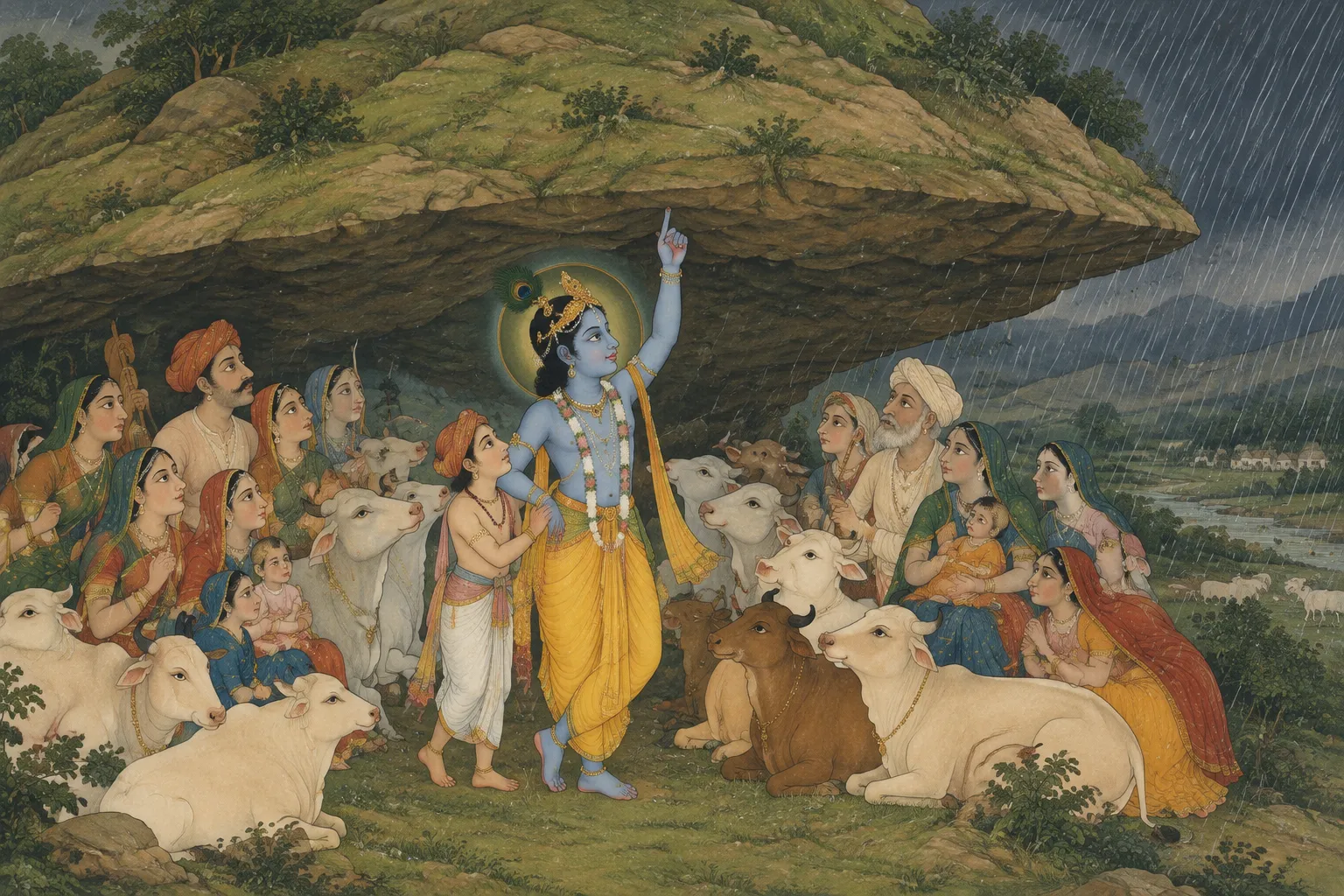
A mountain becomes a roof. Beneath it, a community gathers with its cattle, waiting for a storm to end. Krishna’s lifting of Govardhana is an extraordinary display of power, but the question that makes the episode especially rewarding is not simply how he raises the hill. It is why this particular hill becomes the instrument of protection.
The answer begins before the rain. In the Bhagavata Purana’s tenth book, chapter 24, Krishna redirects an offering intended for Indra toward the cows, Brahmanas, and Govardhana. The hill subsequently becomes the community’s refuge. Reading the two events together reveals a story about where people locate divine care—and how they recognize it.
1. A question before the offering
This article follows the Vaishnava narrative in the Bhagavata Purana, chapters 10.24–25, using G. V. Tagare’s English translation. Its setting is the cowherding community of Vraja, associated with Vrindavana. It should not be treated as a transcript of every regional telling or every devotional interpretation of Govardhana.
As preparations proceed, Krishna asks Nanda, his father, what the rite accomplishes. Nanda explains that Indra supplies the rain on which livelihood depends. Krishna counters by emphasizing action, natural disposition, and the community’s cattle-based subsistence. Their exchange appears in 10.24.3–25.
There is a useful distinction here between asking whether worship matters and asking what a particular act of worship means. Krishna’s questions invite the second inquiry. Read as a literary scene, the conversation makes religious understanding something that must be articulated, rather than merely assumed.
Nanda’s position also deserves a sympathetic reading. Gratitude for the conditions of survival is not foolish. The dramatic tension comes from the possibility that an understandable explanation may still be incomplete. Readers need not dismiss the father to appreciate the son’s challenge.
2. Why the hill matters before it rises
Krishna proposes using the collected materials for a different sacrifice. The instructions include cooked food, milk preparations, offerings through sacrificial fire, food distribution, grass for cows, and a circuit around Govardhana. Most strikingly, Krishna manifests another form, identifies himself with the mountain, and receives the offerings, as narrated in 10.24.26–38.
The mountain therefore cannot be reduced to a convenient piece of scenery. Within this narrative, it is already involved in the relationship between Krishna and the people before the storm begins. The later miracle develops an association that the offering has established.
One possible reading is that the story brings devotion close to the material conditions of life. Food, animals, landscape, and worship are not separate subjects placed beside one another. They belong to one field of responsibility. That is an interpretation of the episode, not a claim that the text offers a modern environmental programme.
Nor should the change be described simply as the abolition of ritual. The more interesting question is what changes when ritual attention is redirected. Readers interested in that distinction can also explore the role of yajna, or sacred offering, in Hindu texts.
3. The storm tests the meaning of power
In the next chapter, Indra responds with destructive clouds, wind, hail, and flooding. People and cattle suffer together. Krishna raises Govardhana with one hand, reassures the frightened community, and holds the shelter for seven days. Indra finally recalls the clouds. These events form the central action of chapter 10.25.
A straightforward reading sees a contest between unequal powers. A more searching reading asks what each power is for. Authority can demand recognition, or it can make room for vulnerable lives. The contrast gives the miracle an ethical shape without requiring us to turn it into a simple moral slogan.
Notice, too, the difference between winning an argument and providing refuge. A persuasive speech does not, by itself, keep anyone dry. The narrative moves from explanation to action, inviting readers to judge protection by what it does for those who need it.
This is why the shelter matters as much as the raised mountain. If we imagine only Krishna’s strength, the people below can disappear from view. Keeping them in the picture changes the question from “Who is strongest?” to “What does strength make possible?”
4. A Kangra painting gives the shelter a human scale
A later visual interpretation makes that question especially vivid. The Cleveland Museum of Art holds a painting from the Pahari kingdom of Kangra, dated about 1780–90, made with gum tempera and gold on paper. Krishna supports Govardhana on his little finger, looks toward Radha, and touches a child’s head. Balarama offers support with a staff; people and cattle cluster beneath the hill, while Indra rides his elephant above.
This is a named regional artistic witness, not a neutral illustration of every detail in the Sanskrit narrative. Tagare’s rendering of 10.25.19 says Krishna raises the hill with one hand; the painting chooses the little finger. The distinction is worth preserving rather than smoothing away.
As an interpretation of the composition, the small gesture toward the child is particularly revealing. Monumental protection and personal attention occupy the same moment. The eye can move from the immense burden overhead to an ordinary human need below.
Balarama’s staff creates another question for the viewer: must participation be necessary in order to be meaningful? The museum identifies the gesture as added support. Beyond that description, we might read it as an image of companionship beside divine sufficiency—not an engineering explanation of how the mountain stays up.
5. Reading Govardhana as more than a feat
At the close of chapter 10.25, Krishna restores the hill and receives the community’s affectionate response. The episode ends not merely with a defeated storm, but with renewed closeness.
That ending helps explain the reader’s payoff. Govardhana need not be approached only as a marvel whose scale exceeds ordinary experience. It can also be read as a way of thinking about dependence: what sustains life, what deserves gratitude, and what kind of authority merits trust?
The hill’s two roles hold the narrative together. It receives reverence and then provides refuge. In this reading, sacredness is not presented as distance from everyday life. It becomes intelligible through shelter, nourishment, and relationship.
Such a reading does not exhaust the episode’s devotional meanings. It offers a focused way into them. Look again at the mountain overhead, then at those gathered underneath: the wonder is not diminished when attention turns from the weight being lifted to the lives being protected.
Sources and further reading
- Bhagavata Purana 10.24, translated by G. V. Tagare: the debate and Govardhana offering.
- Bhagavata Purana 10.25, translated by G. V. Tagare: the storm, shelter, and return.
- Cleveland Museum of Art, Krishna Lifting Mount Govardhan: the Kangra painting and its interpretation.


