
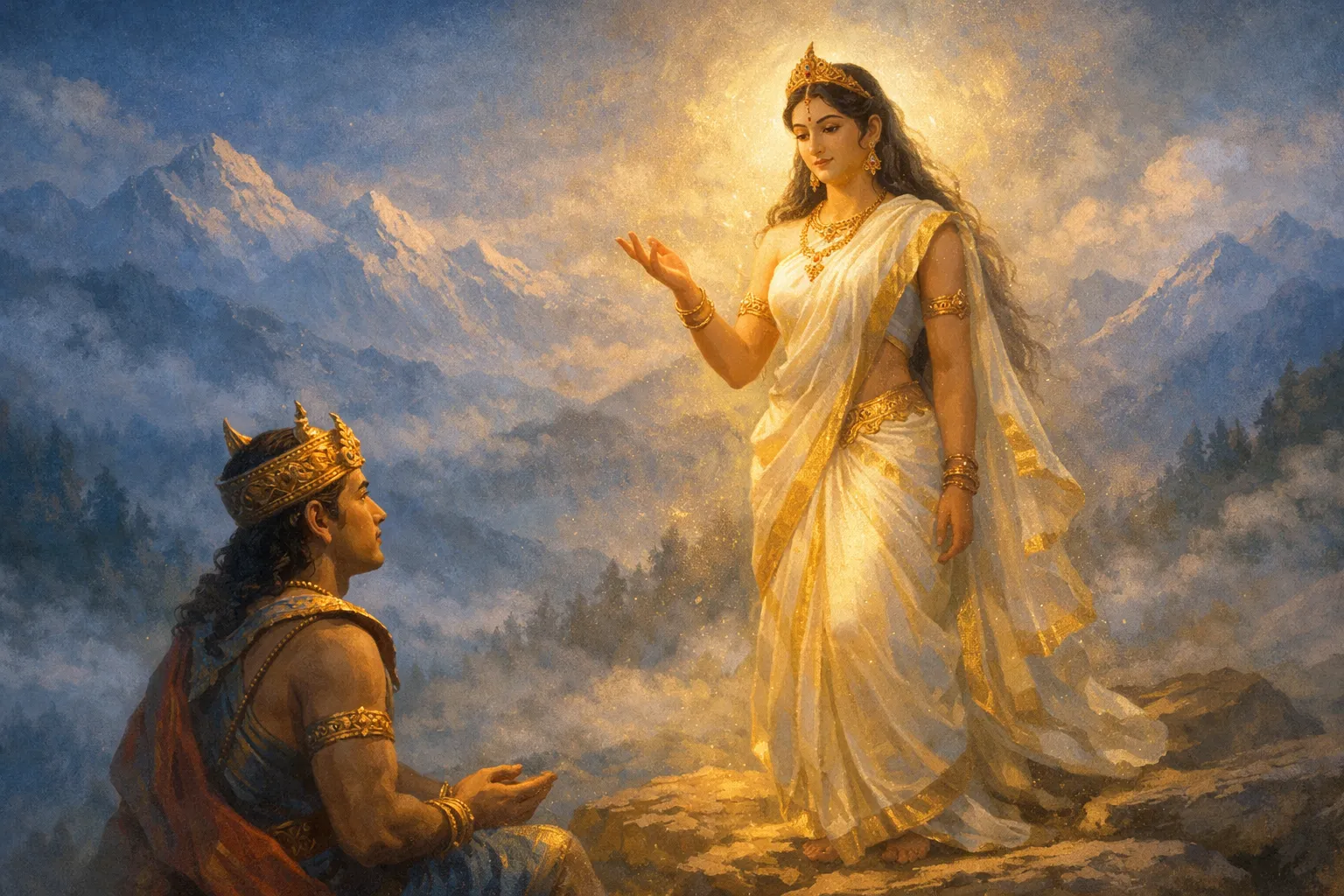
Agni can burn everything on earth—or so he declares. Yet when a mysterious visitor sets a straw before him, the fire god cannot consume it. Vayu makes an equally sweeping claim about his power to move things, then cannot shift the same small object. Indra approaches next, but the visitor disappears. Understanding comes only when he encounters Uma.
This sequence, told in the third and fourth parts of the Kena Upanishad, asks a sharper question than which deity is strongest. Why do extraordinary powers fail to produce knowledge? And why must Indra listen to a teacher before he can understand what has happened?
A victory the gods misunderstand
The story begins after a victory, not during a battle. Brahman has secured success for the gods, but they attribute the achievement to themselves. Their mistake concerns the source of their power: they possess real capacities but misunderstand their independence. Brahman then appears before them in a mysterious form that they cannot identify.
Swami Paramananda’s translation and commentary distinguishes Brahman, the ultimate reality, from Brahma, the creator deity. That distinction matters here. This is not simply a contest in which one recognizable member of a divine assembly defeats another. The gods confront the reality on which their own activity depends, without recognizing it.
The narrative also withholds the details a battle story might emphasize. We receive no extended account of weapons, armies, or heroic maneuvers. The consequential event is the interpretation of success afterward. Victory has not made the gods wise; it has encouraged an assumption that now needs correcting.
Why fire and wind fail the same small test
Agni and Vayu undergo closely parallel encounters. Each goes to investigate the visitor. Each is asked his identity, then his power. Each describes an immense capacity. The visitor answers neither boast with an argument: instead, he supplies a straw and a task appropriate to that god’s own claim.
In Kena Upanishad III.3–10, Agni cannot burn the straw and Vayu cannot blow it away. Both return unable to explain the mysterious being. Their failure is therefore double: their action fails, and their investigation produces no identification.
The straw makes the contrast memorable. A mountain might suggest a rival force strong enough to resist them. A tiny, ordinary object removes that explanation. Read within the story’s opening claim about Brahman’s victory, the test exposes the limits of power treated as a self-sufficient possession.
This also helps connect the episode to the Upanishad’s opening questions. Before telling the story, the text asks what directs mind, speech, sight, and hearing. The divine encounters give that inquiry a narrative shape: being able to perform an action is not the same as knowing what makes the action possible. Fire’s predicament dramatizes the question rather than merely illustrating an unfortunate loss of strength.
Indra’s difference: he asks Uma
Indra does not succeed by applying more force. Unlike Agni and Vayu, he receives no test involving the straw. The mysterious being vanishes as he approaches. In the same space, he encounters a beautifully adorned woman, named Uma Haimavati. In Paramananda’s rendering, she is associated with the Himalaya.
Indra asks her about the mystery, and Uma identifies it as Brahman. She also corrects the gods’ account of their victory. The text explicitly connects Indra’s knowledge with her words: explanation, not superior force, completes the encounter.
Uma is therefore not an ornamental appearance after the action has ended. Her teaching resolves the question that the gods set out to investigate. Without it, failed demonstrations and a disappearance would remain puzzling events. She supplies the recognition that turns experience into understanding.
The next verses give Agni, Vayu, and Indra distinction because they came closest to Brahman, with Indra singled out for knowing first. The surprising turn is that his distinction depends on receiving instruction. Within this episode, needing a teacher does not diminish his standing; it is integral to how that standing is explained.
Two commentarial readings of Indra’s instruction
Later interpretation makes the teaching relationship still more explicit, though it does not produce a single uniform explanation. Two English editions preserve useful examples: S. Sitarama Sastri’s translation of Shankara’s commentary and Srisa Chandra Vasu’s edition of Madhva’s commentary. These are distinct interpretive witnesses, not interchangeable descriptions of everything the Upanishad itself says.
On the verse praising Indra, Shankara’s commentary emphasizes a chain of knowledge. Indra hears from Uma; Agni and Vayu learn from Indra. His primacy is explained through receiving the teaching first and its subsequent communication. This short explanation keeps attention on how recognition passes between teacher and hearer.
The English edition of Madhva’s commentary on the third section places the event within a more elaborate divine hierarchy. It identifies the Lord with Janardana and describes Uma, Shiva, and Brahma accompanying him. These additional participants belong to this commentarial account, not to the spare sequence narrated in Paramananda’s translation of the Upanishad.
That edition explains the disappearance in terms of Indra’s readiness: Uma is the appropriate instructor for him at that point. The emphasis differs from the brief Shankara passage. One foregrounds the transmission of knowledge; the other develops an account of who is fitted to receive instruction from whom. Neither makes Indra’s physical strength the means of his understanding.
More than a warning against pride
Humility is an important lesson here, but reducing the episode to a warning against boasting loses its connection to the rest of the text. The Kena begins by asking about the power behind familiar faculties. In its second part, it challenges the confidence of someone who believes Brahman has been fully understood. The gods’ self-congratulation then makes that misplaced certainty visible in action.
In Paramananda’s translation of the opening sections, Brahman is not simply another object available to ordinary sight, speech, or thought. The story’s unknown visitor gives this difficulty dramatic form. The gods can approach, speak, and attempt tasks, yet those familiar capacities do not automatically yield recognition.
Uma’s explanation prevents the episode from ending in mere bafflement. The lesson is not that inquiry is pointless. Rather, the narrative distinguishes possessing a faculty, using it, and understanding its ground. Its ending also returns to disciplined religious life: the final verses name austerity, restraint, prescribed action, the Vedas, and truth as supports of the teaching.
For readers exploring how instruction works elsewhere in these texts, our discussion of the teacher’s role in the Upanishads offers a natural companion. The Kena’s distinctive contribution is its reversal of expectation: gods who have won a victory still need to learn what victory means. Indra moves beyond the failed demonstrations not by mastering the mystery, but by asking Uma and receiving her answer.
Sources and further reading
- Swami Paramananda, The Upanishads: the Kena translation and accompanying commentary, especially parts III–IV.
- Shankara’s commentary on Kena Upanishad, verse 28, translated by S. Sitarama Sastri: Indra’s knowledge from Uma and its transmission.
- Madhva’s commentary on the third section, in Srisa Chandra Vasu’s English edition: an expanded theological interpretation of the encounter.


